
Blanco County Supervision Types
A released Blanco County person may be under one of several legal controls. The name of the status decides which office can verify it. Parole and mandatory supervision are tied to a TDCJ sentence. The Texas Board of Pardons and Paroles makes release decisions, and the TDCJ Parole Division manages supervision after physical release. Probation, formally called community supervision, is imposed by a court and administered through the 33rd/424th Judicial District Community Supervision and Corrections Department. Pretrial bond supervision occurs while charges remain pending. It is not parole and does not show that a sentence has been imposed.
| Status | Who controls the record | What it means |
|---|---|---|
| Parole | TDCJ Parole Division and Board | Release from prison while the sentence continues under conditions. |
| Mandatory supervision | TDCJ Parole Division and Board | Conditional release based on time-credit law and, for many cases, Board approval. |
| Probation | Sentencing court and 33rd/424th CSCD | A court-ordered community sentence or supervision term. |
| Bond supervision | Trial court and CSCD program | Conditions while a criminal case is still pending. |
These labels also affect release proof. A county booking record can show when someone left Blanco County Jail, but it may not state the full supervision terms. A TDCJ status response or parole-office record supports a parole inquiry. For probation, use the signed judgment, conditions, and CSCD record. A transfer from the jail to TDCJ is continued custody, not community release.
- Discharge
- The sentence or supervision obligation has ended.
- Absconder
- A person alleged to have stopped reporting or left supervision without permission.
- Detainer
- A request by another agency to hold or receive a person.
Verify Blanco County Release Supervision
Start with the release source and do not treat a name search as conclusive. TDCJ’s online offender search contains only people currently incarcerated in a TDCJ facility. A parolee or fully discharged former prisoner may no longer appear there. Blanco County Jail records cover the local exit event, while court and supervision records explain the legal status that followed.
- Obtain the Blanco County Sheriff booking and release entry. Ask for the release manner, date, time, and destination.
- Read the latest signed court order or judgment. Look for probation, bond conditions, transfer, or a state-prison sentence.
- For parole or mandatory supervision, check the TDCJ county-to-office directory and contact Austin I.
- For probation or bond supervision, contact the sentencing court and the 33rd/424th CSCD. Do not ask CSCD to confirm state parole.
- Use the TDCJ status lines when a parole vote or scheduled release is still being processed. Preserve the exact label used by the agency.
A person absent from a current jail roster may have bonded out, transferred, or entered another agency’s custody. The full Blanco County released-inmate search and records path is set out on the Blanco County released inmates home page. Match at least two identifiers, such as date of birth and a TDCJ, SID, booking, or case number.
Blanco County Parole Office Route
TDCJ maps Blanco County parole and mandatory-supervision cases to Austin I District Parole Office in Region IV. The official regional page should be checked before a visit because staff assignments can change. It currently lists Kimberly Mach and gives the following office contact. This office is the right state route for a person released from TDCJ under parole conditions, not for a person placed on probation by a Blanco County court.
1616 Headway Circle, Second Floor
Austin, TX 78754
Phone: 512-339-9142
Fax: 512-908-9382
Official Region IV office page
Before a Board vote, TDCJ directs status questions to 844-512-0461. After approval, the Parole Division release-status line is 512-406-5202. A favorable vote is not proof that physical release occurred. Ask whether the answer is a vote, a scheduled release, or an actual release event.
The official screenshot of the TDCJ Region IV parole offices shows the Austin I contact route used for Blanco County cases.
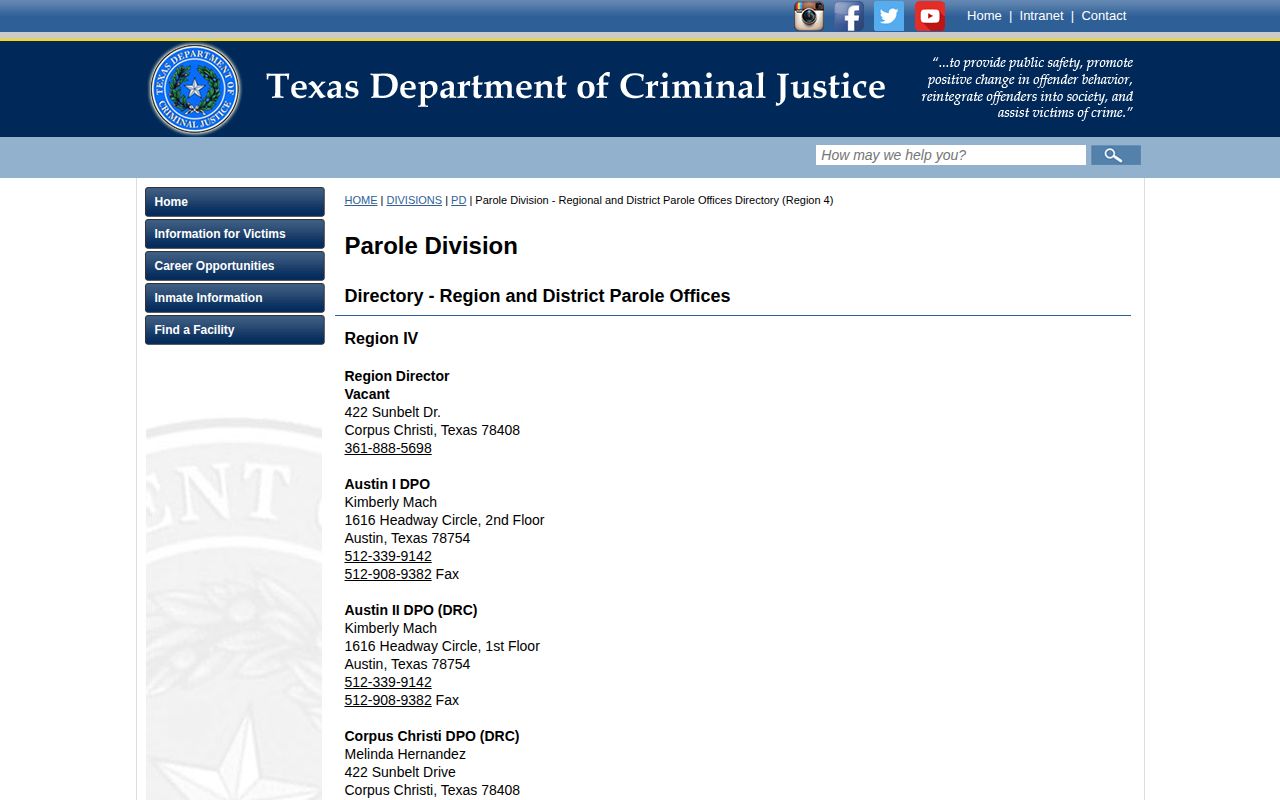
The office listing helps separate state parole from the local CSCD route and should be rechecked before travel.
Blanco County Violation Status
Supervision conditions come from the controlling order and agency. An alleged violation can lead to investigation, modified conditions, an intermediate sanction, a hearing, or return to custody. It does not automatically erase the original release. TDCJ’s Warrants Section receives parole-officer reports, electronic or GPS alerts, and facility reports. Its round-the-clock Command Center can enter, change, and withdraw warrants through law-enforcement systems.
There is no official public name-search list of Blanco County parole absconders in the research. A missing web result therefore proves little. The assigned parole office or proper authority must confirm a warrant or absconder status. VINELink may report a later custody event when the participating agency sends one, but it is not a warrant database and does not replace the supervision file.
Blanco County Supervision Discharge
Supervision ends through an agency or court event, not through the passage of an assumed date. A parole discharge concerns a TDCJ sentence. Probation completion or early termination must be supported by the sentencing court and CSCD record. Revocation instead may return the person to custody. Ask for the final order, discharge entry, or agency status response and retain the record’s exact terms.
Texas public-record rules do not make every supervision detail open. Government Code Chapter 552 supplies the request framework, while specific exceptions, court orders, and confidentiality rules may limit disclosure. Section 552.221 calls for prompt production within a reasonable time, not an automatic fixed production date. A narrow request for the status, start and end dates, and final disposition is easier for a custodian to process than a demand for the complete case file.
Note: Discharge ends the stated obligation; it does not by itself erase the arrest, court, jail, or prison record.
Blanco County Probation Contacts
The 33rd/424th Judicial District CSCD serves Blanco, Burnet, Llano, and San Saba Counties. Its 2024 director posting describes a four-county system with district, county, drug-court, specialized, bond-supervision, and intermediate-sanctions work. Any systemwide caseload figure belongs to the whole district and must not be treated as a Blanco County count.
220 South Pierce Street
Burnet, TX 78611
Phone: 512-756-5473
Use the headquarters as the safer current route. Ask which office owns the named case and verify reporting instructions directly. A probation record should be matched to the court and case number, especially when names are common.
Blanco County Parole File Review
Texas does not conduct a formal public hearing for each parole or mandatory-supervision case. Board panel members review files and vote one after another. A three-member panel generally needs two matching votes for a decision. TDCJ says an initial file is usually pulled before eligibility, while a later review is prepared closer to the next review period. Public Board meetings concern policy and public business, not named offenders.
The official Texas parole review explanation shows why there is no individual hearing calendar to search.
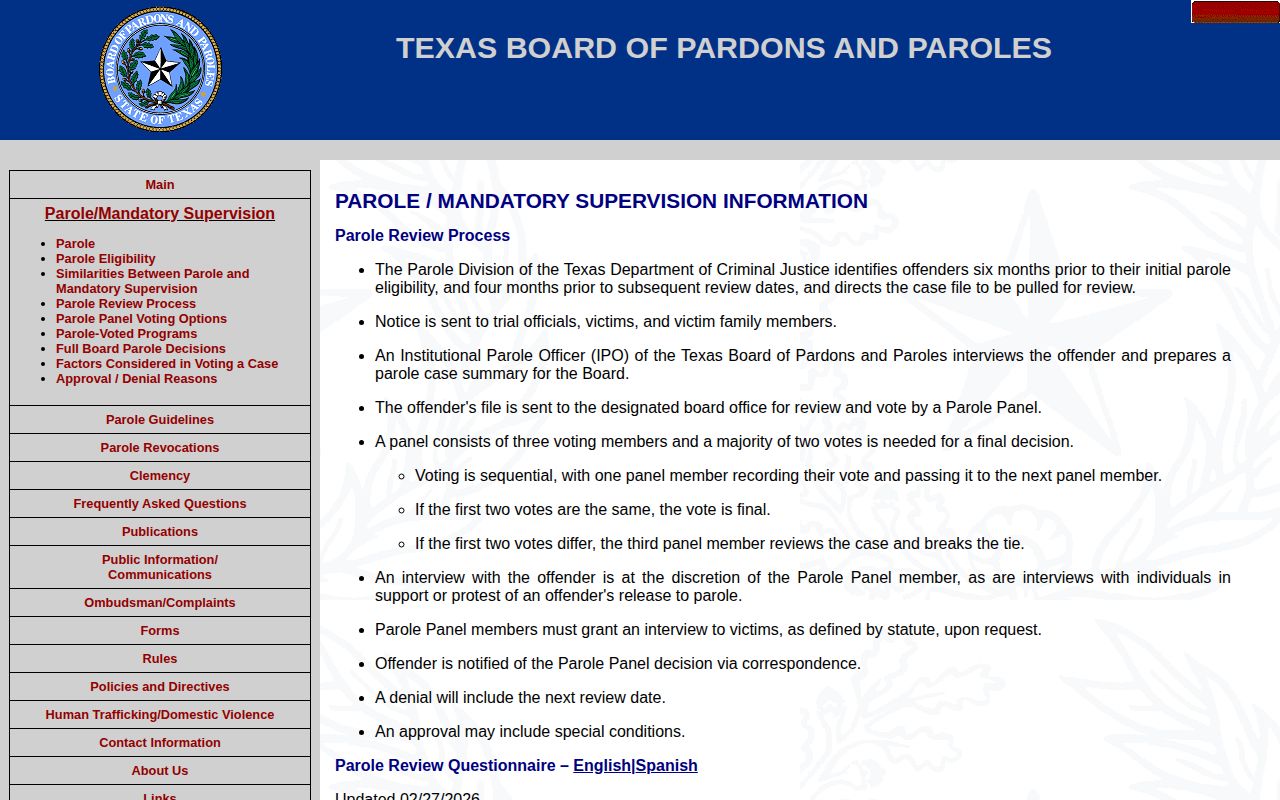
A vote code can describe approval, a future month, a required program, mandatory supervision, denial, or a later review. It is still not an actual gate-release record. Confirm final scheduling through TDCJ and the Austin I route.
The Board may withdraw an approval if new information arrives. After release, an alleged violation can lead to notice, a hearing where applicable, changed conditions, treatment, an intermediate sanction, or revocation. Those later events do not erase the original release, so preserve both the release record and any later supervision action.
Blanco County supervision verification is strongest when the release entry, court case, and agency status all point to the same legal state. Keep the dates and labels from each source instead of merging them into one assumed outcome.
The Texas Board file-review process adds another useful distinction. A file is generally prepared months before the applicable review point, and two members of a three-person panel decide the result. Approval codes can require a program, set a future release period, or address consecutive cases. Denial codes can set a later review or require service of the balance. None is a completed release record. New information can also cause an approval to be withdrawn. For Blanco County parole verification, record the vote code and date, then use the Board status route before approval or the Parole Division status line afterward. The Austin I office can confirm the supervision route once release has occurred.