
Blanco County Release Date Labels
A projected release date is TDCJ Classification and Records’ current calculation of when a confined person may leave if parole does not occur sooner. It can change. A parole eligibility date only marks the first statutory point for consideration. A scheduled release date, type, and location are more operational, but processing can still change them. Actual release or discharge belongs in a completed agency record.
A person awaiting trial at Blanco County Jail has no sentence-based date to calculate. Bond, a signed court order, dismissal, another hold, or transfer controls the next event. Even a sentenced county-jail term uses local credit and Sheriff policy, not TDCJ prison math.
Find Blanco County Projected Dates
First identify the custodian. TDCJ’s search covers people currently incarcerated in a TDCJ facility. It does not serve as a historical locator for parolees or discharged former prisoners. A local jail transfer to TDCJ is continued custody.
- Check the Blanco County Sheriff and court record to learn whether the person remained local, was released, or transferred.
- For state custody, open the TDCJ offender search.
- Search by TDCJ or SID number when known, then compare name and identity fields.
- Open the detail and record the projected, parole-eligibility, maximum-sentence, and scheduled-release fields separately.
- For a county sentence, request the Sheriff time sheet and calculation plus the signed judgment.
- If the person no longer appears in TDCJ, use TDCJ records, parole status, and court channels.
The Blanco County release-record search supplies the full path for a person who has already left a roster. Never turn a no-result into a completed-release claim.
Blanco County TDCJ Date Fields
The TDCJ result columns include name, TDCJ number, race, gender, projected release date, assigned unit, and age. The detail can add SID number, maximum sentence date, current facility, parole eligibility, visitation eligibility, and a scheduled-release block. Offense history can include offense and sentence dates, conviction county, case number, and sentence.
| Field | Meaning |
|---|---|
| Projected release date | A current conditional calculation. |
| Parole eligibility | Earliest consideration point, not a grant. |
| Scheduled release | Planned date, type, and location when set. |
| Maximum sentence date | Sentence endpoint shown by TDCJ. |
| Actual discharge | A completed event verified through agency records. |
The official TDCJ offender search shows the search fields used for a Blanco County state-prison release date lookup.
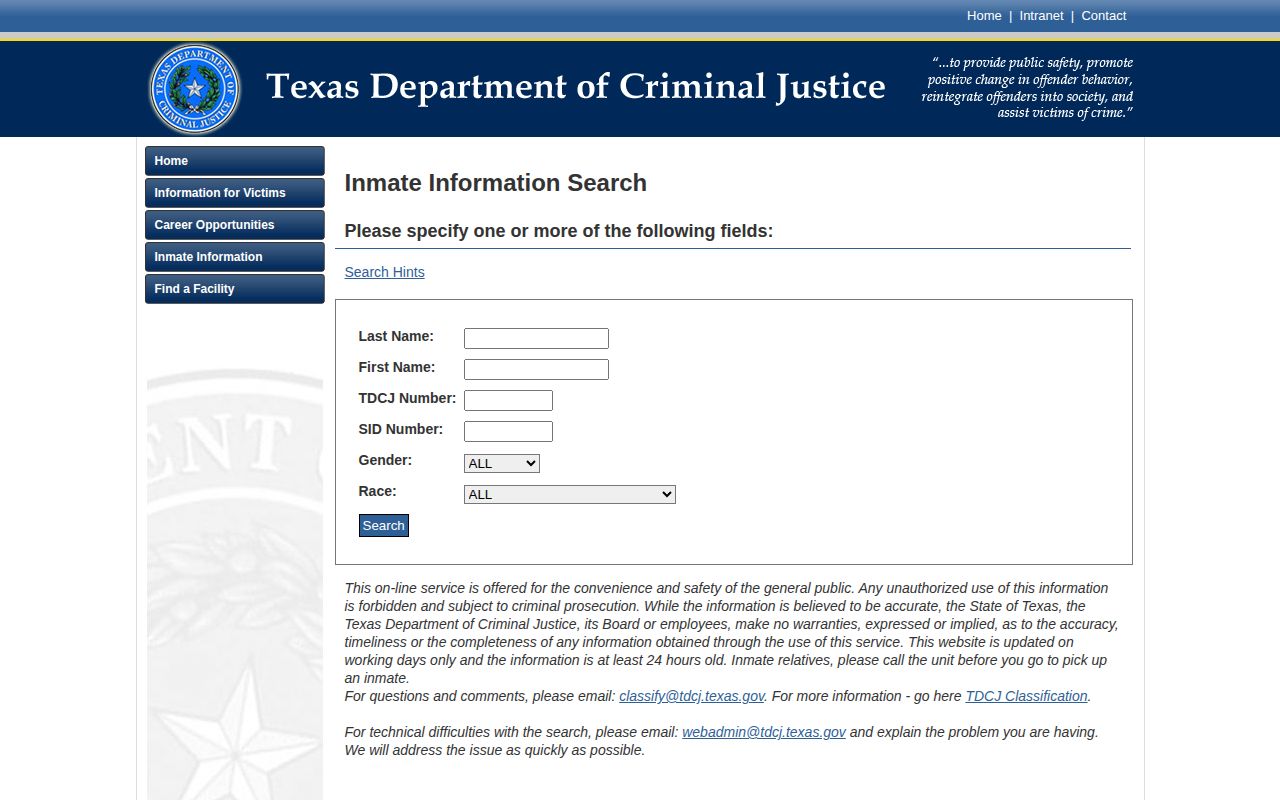
The page warns that its working-day updates are at least one day old, so it cannot confirm a release in real time.
Texas Prison Release Date Math
TDCJ’s projected date depends on offense title and date, mandatory-supervision eligibility, calendar time, good conduct time, Board decisions, and the sentence record. For an eligible offense before September 1, 1996, calendar time plus good conduct time can reach the sentence and cause mandatory-supervision release if parole has not occurred. For many eligible later offenses, the same trigger still needs Board approval. Denial may move the projected date to maximum expiration.
Texas Government Code Chapter 498 says good conduct time affects eligibility for parole or mandatory supervision and does not simply shorten the sentence term. Under Section 498.003, classifications can earn different amounts per period served. Credits are a privilege, can be forfeited, and may depend on classification or program work. Simple subtraction from the sentence is unreliable.
Texas has no general rule that all state prisoners serve about eighty-five percent. For findings governed by current Code of Criminal Procedure Article 42A.054 and related provisions, Government Code Section 508.145(d) uses actual calendar time equal to half the sentence or thirty years, whichever is less, with a minimum of two years before parole eligibility. Other offenses and dates follow other rules. Eligibility is not release.
Blanco County Date Change Factors
Several events can move or replace a date. The agency record should identify the new label and basis rather than forcing every change into “good time.”
| Factor | Possible effect |
|---|---|
| Discipline | Credit forfeiture or classification change can delay eligibility. |
| Parole vote | Approval, denial, required program, or later review changes timing. |
| Detainer or hold | Another agency may receive the person instead of community release. |
| Court order or credit | A corrected sentence or time credit changes the calculation. |
| Consecutive case | Another sentence may control continued custody. |
| Record correction | Classification and Records may revise a mistaken input. |
A favorable parole vote is not proof that the person passed through the release gate. TDCJ directs pre-vote status questions to 844-512-0461 and post-approval release-status questions to 512-406-5202. Ask the representative to label the date precisely.
Blanco County Good Time Differs
Texas Code of Criminal Procedure Article 42.032 permits a sheriff to commute county-jail time for good conduct, industry, and obedience. The deduction cannot exceed one day for each day of the original sentence actually served, and misconduct matters. The sweep found no published Blanco County Sheriff policy that shows how the local discretion is applied.
That county authority is separate from TDCJ Chapter 498 credits. For a person serving time at Blanco County Jail, request the Sheriff’s time sheet, credit calculation, release timestamp, and the controlling judgment. Do not copy a state-prison projected date formula into a county sentence.
No statewide Texas criminal-release rule was verified that automatically moves a Sunday or holiday expiration to Friday. Ask the jail about actual processing. Court credit, holds, consecutive cases, discipline, and calculation corrections can all change the result.
Note: County good time is permitted by statute, but no published Blanco policy supports predicting a specific award.
Confirm Blanco County Release Timing
TDCJ’s email guidance allows a request to pia@tdcj.texas.gov with the full name and seven-digit TDCJ number. Without that number, provide exact date of birth, approximate age, and conviction county. TDCJ says an ordinary response can include location, conviction, incarceration history, and projected release date without a charge. General offender information is also available at 936-295-6371 or 800-535-0283 on weekdays during listed business hours.
For a named person, the Blanco County VINE inmate check can supply an alert if the record offers registration. Confirm that alert with the source agency. For local custody, ask the Sheriff whether departure was community release or transfer and get the exact timestamp and destination.
The TDCJ telephone guidance separates ordinary offender information, Board status before a vote, and Parole Division status after approval. Use the channel that matches the case stage. Give the representative a TDCJ or SID number when possible, then ask whether the stated date is parole eligibility, projected release, scheduled release, or actual discharge.
Blanco County Mandatory Supervision Dates
Mandatory supervision is not the same as parole, even though both can place a person outside prison while the sentence continues. TDCJ’s projected-date explanation distinguishes offenses by date and eligibility. For an eligible older offense, the time-credit trigger can produce release if parole has not happened. For many later eligible offenses, Board approval is still required. A denial may leave the person confined until a later review or maximum expiration.
Government Code Section 508.149 has a separate list of mandatory-supervision exclusions. The offense date and judgment matter because amendments or former law may control. Never apply one person’s formula to another case based only on the offense name. The TDCJ detail, sentence record, and governing statute must be read together.
A Board vote can also require a program before release. Approval codes may set a future month, require treatment or another program, account for consecutive cases, or authorize mandatory supervision. Denial codes can set a later review or require service of the balance. None of those codes proves that physical release occurred.
Blanco County Jail Date Records
For a county sentence, ask for more than an estimated day. The Sheriff time sheet can show calendar time, jail credit, any local commutation, discipline affecting credit, holds, and the final calculation. The signed judgment shows the sentence and court-awarded credit. Together they provide a better basis than counting days from a booking date.
A person can also disappear from the local population through transfer. Blanco County budget records provide for out-of-county boarding and transport, so movement to another jail is a real possibility. A transfer timestamp is not a release to the community. Request the destination and then contact the receiving custodian.
Pretrial timing remains controlled by the court and custody facts. Bond may be posted, an order may be signed, or another hold may prevent exit. A docket entry can explain authority but does not replace the jail’s actual release log. Confirm both the legal event and the physical exit.
Request Blanco County Date Proof
Texas Government Code Chapter 552 provides the public-information framework. Section 552.021 states the general access rule, subject to exceptions, and Section 552.221 requires prompt production within a reasonable time. It does not guarantee production on a fixed day. A custodian may redact protected identifiers or invoke a lawful exception.
Keep the request narrow. Identify the person and booking or TDCJ number, then ask for the release calculation, projected and scheduled date fields, actual release or discharge date, release type, destination, and any public code explanation. A focused request is easier to route than a demand for every record about the person.
After release, the live roster or TDCJ current-inmate search may no longer show the person. The source release entry, incarceration history, parole record, and court judgment are the lasting proof. Keep each field’s original label and date so a future calculation is not mistaken for an event that already occurred.
A reliable Blanco County release-date record keeps the calculation, scheduled action, and completed exit distinct. That distinction remains essential when a later court order, detainer, or Board decision changes the expected timing.
Government Code Section 552.029 also identifies public TDCJ inmate categories that can support a date inquiry. They include identifying data, offense and judgment information, conviction county and court, earliest or latest possible release dates, and parole dates or earliest possible parole dates. That statute does not make the live offender search a historical archive. If the person has already left TDCJ custody, request the relevant incarceration and release information through TDCJ and compare it with the court judgment. For a Blanco County jail term, keep the Sheriff calculation separate because the county commutation statute and unpublished local policy create a different record path.